History

Place of interest Geographical settings of Kandy Religious

Geographical Setting of Kandy

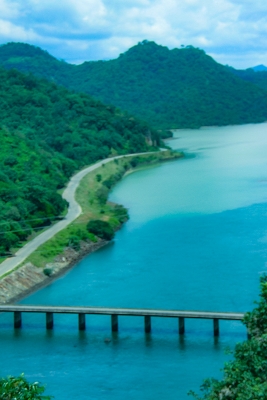
Kandy city is well known for its scenic beauty, favorable climate, cultural values and historical significance. The city is beautified by an inner tier of mountain ridges as Hantana towards south. Udawattekelle to the East and Bahirawakanda towards North west. Kandy is 9.22square miles or 25.4 square kilometers in extent. The city is bounded by the Mahaweli Ganga along the entire western, northern and eastern sections. The river, the longest in Sri Lanka, also provides natural protection as well as a healthy clean environment to the city.

Location
The city of Kandy lies at an altitude between 1500-2000 feet. More precisely, the built-up area at 488.6 meters above sea level in Kandy plateau. Locating at a distance of 72miles(116km) from Colombo city, it is considered as the largest city in the hill country of Sri Lanka, surrounded by a chain of hills. The tributaries of Mahaweli running through the city provide the natural drainage to the city and functions as a natural water outlet.

Topography
Looking at the topography, the hilly areas of the south-western part of the slope runs up to 2700ft (823m), an elevation from the sea level and are mostly covered with unused grass lands at present. But, these lands had been used for coffee and tea plantations during the colonial period, the effect of heavy soil erosion had formed the present bare lands creating rough grass covered hills.


Home
Kandy City
Municipal Council
Heritage Commitee
Arts & Crafts
Festival
News & Events
Inquiry
 
City Map

.


Weather
Taking the physical environmental features, the city falls within the we-Zone of Sri Lanka, where annual average rainfall is around 1905-3175mm (75"-125"(21)). The main rainfall seasons are South-west monsoon cyclonic effect is also frequent. During the Inter-monsoonal seasons, thunderstorm showers are frequent in the central island. Kandy has an average temperature level between a range of 21-26c. During the last 50 years the city has become warmer and has less rainfall. The impact of these changes of the weather pattern has caused instinct changes in natural vegetation on the surrounding hills as well.

The Lake
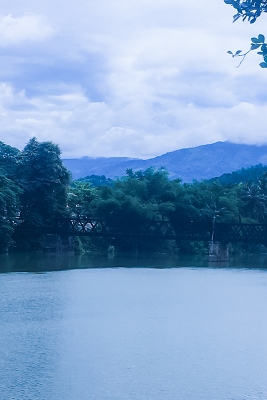
The lake at the center of the city with a traditional artistic feature is attractive and keeps the environment cool. So, the city is considered as one of the best tourist resorts of the island. This was built by the last king converting a stretch of paddy land into a lake over a period of 3 years and completed in 1812. conceptually, it is a monumental creation of 'Kiri Muhuda'. [Milky Sea] The banks of the lake cover with variety of trees of which some are historic. Naturally, the narrow path along the Lake has become the popular walking stretch of the city dwellers and lovers.

The Catchments area
The lower catchments area of the stream feeds the hydrology of the city and are fed by the perennial springs and seasonal rain. A section of Hantana range feeds the streams in the catchments in the tributaries that run through the southern part of the city. The streams and water courses within the city periphery and the city, support the hydrology of the city particularly for domestic use and small scale cultivation of paddy and vegetable. Due to seasonal climatic changes, some streams ceased to flow for a longer period. The lower elevation areas as well as the hills have a fertile soil layer thus still sustains some valuable stretches of paddy lands within the city limits.
Forest Reserves
The city of Kandy, still managed to protect some of the green environment, and forest reservation know as 'Udawatkelle' with a collection of rare trees and environ to highlight the biodiversity within this hill city. The role of forest ecosystems as catchments protection and their role in hydrology had been studied and it is noted that their removal could lead to drier conditions particularly during the dry weather and high peak flows during many rainy seasons with consequent flooding. The forest covering catchments area regulates the quality and the quantity of the water leaving the catchments and prevents erosion, thus maintaining the potectial fertility of the area.

The mountain ridges of Hantana, Udawattakelle and Bahirawakanda with forest covers on top provide a fresh and a green environment to the city. The distribution of the forest cover is shown in Figure1. The forest stretch that stands adjacent to the city's concentric zones, keeping the historic blend and cultural values as "Tapovanaya' is considered as a virgin forest.

I fact it is clear that Udawattakele covering the hill with a dense forest had been conserved since historically reduced during the British rule, it has continued to be a protected area since then, thereby supplying water to the streams originating from the hill. This forest stretch is now monumental environment unit of the urban landscape that attracts tourist as well as locals.
The Landscape
An observer can admire the landscape of Kandy that has formed with hills and low elevation areas at the center. The visual characteristic is that the city space is locked with surrounding hills as barriers to expansion of the city. The most magnificent view is the view of Dalada Maligawa from the ancient of the Kandy lake. The heart of the city is composed of some old buildings as well as modern buildings that can be seen along the Dalada Vidiya. The lake is surrounded by a narrow stretch of tree cover. Some of the trees are quite older and reflect the historic landscape of early 19th century landscape.

The natural environment of the city is mainly reflected by the forest reserves named as Udawattakelle on the east of the built up area and Malwatte on the hills locates towards the southern part of the city. The city landscape is unique in two ways. One, its location amidst the hills and encircled broad river Mahaweli gave a natural protection for the main hub of the Kandyan Kingdom. The vast open valley towards the south west of he city provide a fertile agriculture area at the beginning and at present a mixed land use area. Two, the large forest reserves namely Udawattekele and Malwatte increased the beauty of the cityscape and green area of the city.

The landscape developed around two open spaces, an elongated square at the end of which are the administration buildings of the old capital, and an artificial lake that is quadrangular in form. A public garden adds o the openness of the city's spatial organization. As history records, the city of Kandy was a veritable natural fortress surrounded by the river Mahaweli and a mountainous wilderness impregnable to many an invader. It provided a safe haven not only to the majority Sinhalese in the interior, but also to people of diverse origins including the Mohammedans, Hindus and Christians from the coastal areas who suffered much persecution at the hands of European invaders.

It is our noble duty to preserve and foster the natural and cultural heritage entrusted to us by the generation the historic city and its environment. In the final stage of the last millennium we were increasingly aware of the fragility and endangerment to our cultural and natural heritage of the city. Much of the valuable treasures presented to the city by great kings and people have already been lost. Some have lost identity due to defacement by the acquired cultural values, forced architecture and structure patch works.

The changing nature of the city
Kandy city is the largest urban center in central Sri Lanka that functions as a district and a provincial capital. The city has maintained the cultural dominance and traditional landscape features that have historic importance for over 400 years. The landscape of the city has changed over the years due to the political, economic, social and cultural influence. The city has a long process of urban development on which the present urban problems have emerged. Welfare of the city dwellers and users of urban facilities should be given more emphasis when planning. Any expansion of the infrastructure or a change in the landscape should accommodate urban functional requirements. In a process of urban planning, population component has to be considered as one of the most important criterion as it could positively affect the expansion of housing areas, increasing sources of income, and human resources. The negative effects would be over population, street congestions, emergence and expansion of slum or shanties and urban pollution. As a result of these series of changes, the land use of the city particularly housing are becomes congested, social hazards develop and the peaceful environment could be disrupted. Therefore, a careful study on these effects in relation to population size, density, composition and migratory trends would be necessary prior to a comprehensive planning scheme.

In addition to the largest housing concentration, the city serves as one of the leading commercial centers with a large volume of wholesale and retail transactions and is the second largest educational and health-care enter next to Colombo. Kandy also plays an important role as a judicial center. As a transport center with all types of trans port facilities, It is leading in the central Sri Lanka. The city has a structure that could provide rooming and hotelling facilities to a large number of tourist population. In addition, the concentration of leading banks and financial institutions provide the highest financial services next to Colombo . Kandy also serves as one of the leading communication centers. Therefore, the functional mechanism of the city provides employment and services to a large number of people of the city and its periphery.

Scenic beauty and the existence of historically and culturally significant monuments, institutions and traditions held in high esteem strengthened the momentum of growth generated by the location of these diverse commercial and service functions. The establishment of some national level institutions such as the Royal Botanical Gardens, Department of Agriculture, Veterinary Services and Minor Export Crops, Teacher Training Colleges, the University etc. In and around Kandy during the past several decades provided further stimulus for the growth of Kandy. It has enjoyed a unique position in that it is the only city out side the national capital that has attracted a number of national level institutions in addition to its own district level ones. Together they became an attraction for an increasing concentration of population in and around Kandy starting from the early part of the 19th century.


The Population composition
The Population of Kandy appears to have remained more or less stagnant before the city was occupied by the British from the 17th century up to the end of the 19th century it has been around 2500, at the time British occupation in 1815 it is estimated to have risen to about 3600.5. By 1871 this had increased to 16,881 registering an average annual increase of 8.3% in relation to the base year figure of 3000. According to the latest census data, the population of Kandy in 1981 was 97,872. this shows that the average annual rate of growth during the 110 - year period from 1871 to 1981 has been 4.4% though the inter - census rates have been lower and varied.